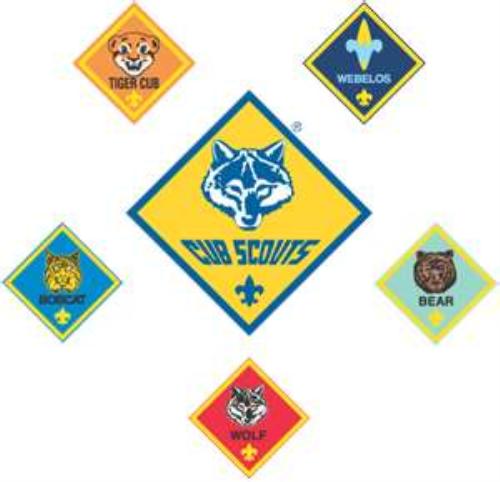
 Cub Scout Advancement and Awards

By joining the Cub Scouts, you've taken your first step on the Scouting trail.
Many people stay in Scouting, one way or another, for many years. Some stay for a lifetime.
Cub Scouting
Boys of different ages have different ranks in Cub Scouting. As you go from Lion Cub (Kindergarten) or Tiger Cub (First Grade) to Webelos Scout (age 10), you learn new things and new skills that you use to meet new challenges as you get older.
- Lion Cubs. Kindergarten boys join Pack 473 as a new member of the Tiger Cub den #10. The Lion Cubs shadow the Tiger Cubs in Den #10 doing many of the
activities together as they work on the Bobcat Award. Pack 473 is one
of the few programs in the world that offer this pilot program and we
are excited about introducing your son to scouting along with the 1st
graders.
- Tiger Cubs. First-grade boys join Pack 473 as a member of the Tiger Cub den #10, where each boy works with an adult partner on the requirements to earn his Tiger Cub badge. To begin his path to the Tiger Cub rank, the Tiger Cub (age 7) must
learn the Cub Scout promise, the Cub Scout sign, and the Cub Scout
salute. When he has learned these, he gets his Tiger Cub emblem, which
is a tiger paw with four strings for beads. He wears the emblem on his
right pocket. As a boy finishes each part of the five Tiger Cub
achievements, he earns an orange bead (for den activities), a white
bead (for family activities), or a black bead (for "Go See Its"). When
the boy has earned five beads of each color, he can receive his Tiger
Cub badge. The Tiger Cub badge is given to the boy's adult partner at a
pack meeting. Then, during a grand ceremony, the adult gives the badge
to the boy.
The Tiger Cub program introduces boys to the
excitement of Cub Scouting as they "Search,
Discover, and Share" together.
- Wolf Cubs.
The Wolf rank is for boys who have finished first grade (or who are 8
years old) and are members of Den #1 in Pack 473. To earn the Wolf badge, a boy must pass 12 achievements.
His parent or guardian approves each achievement by signing his book.
When the boy has met all requirements, the Wolf badge is presented to
his parent or guardian at the next pack meeting. During an impressive
ceremony, the parent or guardian then presents the badge to the boy. After
he has earned the Wolf badge, a Wolf Cub Scout can work on the 23 Wolf
electives until he finishes second grade (or turns 9 years old). He can
choose from more than 100 elective projects that may show him new
hobbies and teach him skills that will be useful during his Boy Scout
years. When he completes 10 elective projects, he earns a Gold Arrow
Point to wear under the Wolf badge. For each 10 elective projects after
that, he earns a Silver Arrow Point.
- Bear Cubs. Boys in the third grade are members of a Bear den. They also work with their families to do the requirements for the Bear badge, but boys this old have enough knowledge and skill to take on more of the work by themselves. There are 24 Bear achievements in four groups. A boy must
complete 12 of the achievements to be a Bear Cub Scout. These
requirements are harder and more challenging than those for the Wolf
badge. When a boy has earned his Bear badge, he may work on electives
to earn Arrow Points to wear under his Bear badge.
- Webelos Scouts
Webelos dens are for boys who have completed third grade (or
reached age 10). The Webelos den program is different from the Cub
Scout den program. Everything in the Webelos Scout program is more
challenging than what younger boys in the pack do. Webelos Scouts get
to work on the 20 Webelos activity badges:
|
Physical Skills
- Aquanaut
- Athlete
- Fitness
- Sportsman
Mental Skills
- Artist
- Scholar
- Showman
- Traveler
|
Community
- Citizen
- Communicator
- Family Member
- Readyman
Technology
- Craftsman
- Engineer
- Handyman
- Scientist
|
Outdoor Activity
- Forester
- Geologist
- Naturalist
- Outdoorsman
|
Webelos
Scouts work on requirements during their weekly den meetings. Once a
boy learns a skill, he practices it at den meetings and at home on his
own. His family helps him at home. Webelos Scouts bring the projects
they do at home to the den meetings to show others, and to have the
Webelos den leader approve their projects.
When a boy has done the
requirements for an activity badge, the Webelos den leader or activity
badge counselor, rather than a parent, approves most of the activity
badges. It takes three activity badges, including Fitness and Citizen,
to earn the Webelos badge.
Besides earning activity badges,
Webelos Scouts can earn the compass points emblem. This emblem is
awarded after a Webelos Scout has earned seven activity badges. For each
four activity badges a Webelos Scout earns after that, he receives a
compass point—east, west, north, and south.
Where you begin in Cub Scouting depends on your age at the time you join. For instance, if you join when you're in first grade, you will begin as a Tiger Cub. If you do not join until the third grade, you'll begin as a Bear Cub Scout. You won't go back and earn the Tiger Cub and Wolf badges.

The
first badge that all Cub Scouts earn, regardless of age,
is the Bobcat Badge.
This badge
requires the Scout to learn
the basic information about Cub Scouting that all
Cub Scouts must learn like the Promise, the scout sign and motto.
The Arrow of Light Award
The highest award in Cub Scouting is the Arrow of Light Award, which you will begin working on as a Webelos Scout. It is the only Cub Scout badge that you can wear on the Boy Scout uniform. As you work on the Arrow of Light Award, you practice outdoor skills, get physically fit, and learn more about citizenship and working with others. All of these things prepare you for the next stage of Scouting.
Boy Scouting
The Boy Scout program is for boys who are 11 years old, are at least ten years old and have finished the fifth grade, or are at least ten years old and have earned the Arrow of Light award as a Cub Scout. The purpose of Boy Scouting is the same as it is for Cub Scouts: to help boys grow into good citizens who are strong in character and personally fit. But because they're older, Boy Scouts have a program with more and bigger challenges.
Boy Scouts work together in groups called patrols. The patrol leader is an older boy, not an adult. The Scouts in the patrol elect their patrol leader.
Patrols are part of a troop. The troop has adult leaders, but their job is to give guidance and advice to the Boy Scouts. The Scouts run their own program.
Boy Scouts have exciting outdoor activities. They go on long camping trips and long-distance hikes. They go canoeing and whitewater rafting, and more. They move through the Boy Scout ranks, from Tenderfoot to Eagle Scout. They earn merit badges that show many kinds of knowledge and skills. Scouts can also earn special awards for feats of skill, such as completing a mile swim or 50 miles of hiking.